2012-06-06

How do the new Sentencing Guidelines impact on cannabis offences - RELEASE

How do the new Sentencing Guidelines impact on cannabis offences

http://www.release.org.uk/comment/375-sentencing-guidelines-for-cannabis-offences

Copyright © 2012 Release Legal Emergency & Drugs Service Ltd. Registered charity number 801118.


Release
 124-128 City Road, London EC1V 2N

We have received a number of emails from cannabis activists asking for clarification on how the new Sentencing Guidelines will impact on cannabis cultivation and possession. Release provided detailed advice to the Council and has welcomed many of the changes in the guidelines as an improvement on the previous regime, but in relation to cannabis, there has only been a slight shift in approach.

With regards to possession of cannabis, there has been very little change from the current Magistrates Sentencing Guidelines. The starting point for sentencing remains the same, that is, a Band B fine. The sentencing range has changed, previously it was Band A fine (A is lower than a B fine) to 12 weeks custody (this covers sentencing for both small and large possession offences). The new guidelines range from discharge (more lenient than before) to 26 weeks in custody (harsher than before). If someone comes before the court in respect of possession of cannabis for medicinal purposes that would mitigate the sentence, and if there were no other factors could reduce it down from a Band B fine. However, it is still a criminal conviction resulting in a criminal record even with an absolute or conditional discharge.

In terms of cultivation and production of cannabis there does seem to have been real movement, but this is primarily due to the recent guidelines in the Court of Appeal case of R v Auton. This case was decided only last summer and provided much harsher guidelines for sentencing cannabis production cases involving yields of approximately 1 kilo. The guidelines stated that:

  • Where there is no element of supply the sentence range is likely to be between 9 – 18 months, depending on size of operation and the defendant’s personal circumstances;
  • Where there is no evidence of commercial supply for profit but there is supply to others the range is likely to be 18 months to 3 years – operation and personal circumstances again relevant;
  • Where the operation is a commercial one but falls below an industrial operation the range will be 3 to 6 years.

The new guidelines are certainly an improvement on R v Auton and sentencing will be determined through a two-step approach. The first step is to determine the role of the offender and there are three potential categories – lesser role, subordinate role or leading role. The second step is the quantity of drugs involved and there are four categories:

  • Category 4 – 9 plants (presumed yield 40gram per plant)
  • Category 3 – 28 plants (presumed yield 40 gram per plant)
  • Category 2 – operation capable of producing significant quantities for commercial use
  • Category 1 -  operation capable of producing industrial quantities for commercial use

The Court will then consider mitigating/aggravating factors.   

In relation to someone who is producing for their own purposes, or even where it is social supply, it is likely they will fall within the ‘lesser role’ category within the new guidelines. In terms of quantity 1kg (25 plants) would fall within category 3. This would lead to a sentencing starting point of a high level community order and a sentencing range of a low level community order to 26 weeks custody, again depending on mitigating and aggravating circumstances. This is definitely an improvement on Auton but there is still a risk of imprisonment especially where there is a previous conviction.

Where someone was growing a lesser quantity (9 plants) and falls within the lesser role the guidance suggests a starting point of Band C fine, with a sentencing range of a discharge through to a medium level community order.  This would then be increased/decreased through aggravating and mitigating factors.  Frankly, this is only a slight departure from current Magistrates guidelines which state that the starting point for small scale cultivation is a Band C fine and the range is Band B fine to low level community order.

So overall, whilst we are pleased that our advice has been followed to some degree and has impacted on other areas of sentencing, the general approach to cannabis offences has not shifted a huge amount, and cannabis activists should be aware that the offences remain criminal, and so can result in a criminal conviction. There is also no evidence to suggest that the police will de-prioritise the policing of cannabis cultivation.

Fine Bands

Fine A – Starting point 50% of relevant weekly income; Category range 25% - 75% of relevant weekly income 
Fine B – Starting point 100% of relevant weekly income; Category range 75% - 125% of relevant weekly income 
Fine C – Starting point 150% of relevant weekly income; Category range 125% - 175% of relevant weekly income

If anyone has any questions on the new guidelines please feel free to comment below and we will respond as soon as possible.

If anyone needs legal advice please contact the helpline on 0845 4500 215 or 020 7324 2989. 
 

Comments 

0#196 Max blunt 2012-06-01 15:21
Quoting john:
I'm slightly confused..what do they consider a proffesional grow or a repeat grow......let's say I had between 2 and 6 plants in a tent which I would only use for personal......where would that put me in terms of sentencing....confusing

If you had six plants in flower, with no bud found and nothing cropped off the plants, that would be Cultivation. If you had six plants, but say 2 were in flower and you had two cuttings and two mothers, well that would be Production.
If it was all in a purpose built room as well, then you would most likely get a custodial.
After the ruling from the appeal court it looks like the only way to grow and not get a custodial is to use a tent with 4 plants maximum, no cuttings and no mothers and most certainly no dried bud. [ Make sure you stash it damn well, and take nothing for granted.

Quote

0#195 dave 2012-06-01 12:25
hi john that would put you in catagory 4, lesser role. unless there were many aggrivating factors but im confident you will be in those sentencing guidlines.
Quote

0#194 john 2012-06-01 11:23
I'm slightly confused..what do they consider a proffesional grow or a repeat grow......let's say I had between 2 and 6 plants in a tent which I would only use for personal......where would that put me in terms of sentencing....confusing
Quote

0#193 dave 2012-05-31 22:51
thanks guys ... i will check on here from time to time to try and help anyone else that finds themselves in a similar situation
Quote

0#192 Max blunt 2012-05-31 15:27
It's the word 'capable', surely it is not the capability but the "intent & action" of the accused which can be punished. Otherwise, there exists an assumption of guilt.

Not my words I would like to add, but very well put.

I would be interested in your opinion.

Quote

0#191 Release 2012-05-31 15:22
Thanks for that article Max. Those comments are worrying as repeated grows isn't a criteria referred to in the guidelines. Though it seems they have had guidance from the Court of Appeal. 

In my opinion someone growing for their personal use, even with repeated grows, should still be considered as being in a lesser role.

Quote

0#190 Max blunt 2012-05-31 15:14
@ Release.

Oh yes, I do realise that, it is an absurd situation where we have people sent to Crown Court for a few plants though. Not sure if you have seen this? http://www.sheffieldtelegraph.co.uk/news/local/fifty-cannabis-growers-convict...

Most signicantly, “One of the critical issues is going to be the issue of purpose-built rooms,” the judge told Sheffield Crown Court. 

“The public need to understand that people who set up growing areas CAPABLE OF PRODUCING REPEAT CROPS are going to be regarded by the courts as significant offenders, and they are all very likely going to go to prison - whether employed or not, a family man or not, of good character or not.”

My emphasis.

Quote

0#189 Release 2012-05-31 15:08
Max, I agree it's not necessarily fair, but as I said to Dave previously this is pretty normal for this sort of offence so he hasn't been treated any differently to anyone else.
Quote

0#188 Release 2012-05-31 15:07
That's great Dave - sounds like a good result.
Quote

0#187 Max blunt 2012-05-31 15:06
Hi Dave, really glad you didn't get a custodial. I have to say though, there is nothing "fair and just" about being sent to Crown Court for a few plants.
Quote

0#186 dave 2012-05-31 15:02
hi guys , went crown today, my barrister was brilliant five stars! he argued my case should be in lower cat 3, the judge accepted this mainly on my health plea. he nearly got me a conditional discharge! i ended up with a community order and gate way project with probation. all in all a fair and just result!
Quote

0#185 Max blunt 2012-05-24 17:24
To be honest, if I were to be arrested for growing again, and after the treatment I got off the muppets that pass for magistrates, I would opt for Crown Court anyway.
So take heart.

Max

Quote

0#184 Max blunt 2012-05-24 17:19
Crown Court for 16 plants is outrageous on any level.
Best wishes.

Max

Quote

0#183 dave 2012-05-24 17:14
thanks alot mate... yes it does seem like the cps at magistrates were excessive, ive got crown on the 31st of may ill let u know what happens
Quote

1234567891011»

Copyright © 2012 Release Legal Emergency & Drugs Service Ltd. Registered charity number 801118.


Release
 124-128 City Road, London EC1V 2N
J

Posted via email from projectbrainsaver

2012-06-05

Queen Put at Risk by Workfare Provider - eddie gillard

Queen Put at Risk by Workfare Provider

http://eddiegillard.wordpress.com/2012/06/03/queen-put-at-risk-by-workfare-provider/

1306157961queen-elizabeth-ii-british-elite-1

At 2300 Saturday 2nd of June 2012, a coachload of Tired, untrained and ill equipped people left Bristol by coach for London and the Queens Jubilee.

At around 0240 they were dropped off by the side of a road with their Baggage and Tents and left stood for more than an hour along with 80 other people.

Having Had no sleep at 0415 these people were told that at 0500 they would be starting a 16 hour shift.

No these are not migrant workers, these are Security Staff for the Queen.

Ages ranging from 16 to 50 with one thing in common. Unpaid and on “work experience”.

Almost all of those that left Bristol last night were still not SIA qualified, Some had been told they would be paid for working and that they should “Sign Off” benefits before starting, which turned out to be a falsehood, mistake or lie, I cannot say which.

But at the very least I can say that Tomorrows People, the DWP Service provider, who handle these people, are Failing them Badly.

Tomorrows people Placed young claimants on an SIA style course with a company who Break DWP rules and Regulations on working Hours, Travel distance and Responsibility for Training and Equipment.

For some this will be the First experience of work, for some it is the First time they have been away from home, for all of them it will be one of the most depressing and soul destroying things they will have done.

So “Why do they do it?”

All those people have been promised Proper paid work at the Olympic Games with pay of up to £9000 for doing it.

Well a carrot like that to people who may not have worked in a long time if at all can make them do the most stupid things.

Tomorrows people Need to sort out their so called subcontractor.

The Organisors of the Jubilee need to vet their security subcontracters more carefully.

And the DWP need to make sure that All those promised paid work during the games are given it.

Hopefully none of the untrained security staff who have all been up for more than 12 hours so far will be called upon to protect  the Queen, because they will be unable to do anything due to exhaustion.

Additional.

Last night I drove  to a campsite just off the M11 and collected 2 of the people let down by CPuk, who, it turns out organised (if thats the right word) this clusterfck of Work experience.

When I arrived close to 2300 hours They were stood in a field soaking wet, shivering with cold and close to exhaustion. One was dressed only in Shirt and slacks as she had not been provided with any waterproof coat, save for a lightweight poncho and a hi vis vest for the jubilee event.

Some muppet had put up their tents with doors open and the insides were soaked along with their possessions, even if they had decided to stay they would have to have sleep in wet tents and sleeping bags.

At 0900 Sunday morning they had been given a paper bag with a Sandwich, Muffin and packet of crisps in and told ” dont eat that now its your lunch”. A paper bag, in heavy rain, 3 hours before lunchtime with no way of keeping it dry.

One of them had been refused use of toilet facilities  and hadnt been able to P for almost 24 hours, she had been forced to change into ” uniform” for the event in the open as there were no changing facilities with other male staff refusing to give her privacy, ” I had to change next to a van in public and a bloody red bus stopped almost right in front of me”..

This is a young woman , First time in london, first time away overnight without a member of her family trying to comply with DWP rules.

Well as far as I am concerned she did herself proud. While others had given up and left in the morning , she stuck it through til after the Queen had passed and the crowd dispersed before asking for help.

She has taken a couple of photos and has agreed to send them to me when she wakes for posting.

She slept almost all the way back to Bristol last night, and when she was helped into her home byan elder brother she was obviously finding it hard to walk.

I had only had to drive up and back and I felt like crap when I got into my home 20 minutes later.

As an additional comment I hope that Prince Philip gets better soon.

http://www.guardian.co.uk/uk/2012/jun/04/jubilee-pageant-unemployed for Press cover.

It is a shame however that contrary to Close Protection uk statement that training had been completed, I know that some staff had not yet been trained in First Aid ( a requirement) or taught how to safely restrain people without causing injury ( a requirement).

To say that this was to weed out those unsuitable for working in the security industry is pure BS. Close Protection uk wanted free labour.

Under London Bridge where the Work Experience Kids had to spend the early hours of Sunday Morning before their long shift Staffing the Jubilee Celebrations

Posted via email from projectbrainsaver

2012-06-04

Say goodbye to your mouse and keyboard. Leap represents an entirely new way to interact with your computers. It’s more accurate than a mouse, as reliable as a keyboard and more sensitive than a touchscreen. For the first time, you can control a comput

Leap

http://live.leapmotion.com/about.html

Read FAQs


Say goodbye to your mouse and keyboard.

Leap represents an entirely new way to interact with your computers. It’s more accurate than a mouse, as reliable as a keyboard and more sensitive than a touchscreen.  For the first time, you can control a computer in three dimensions with your natural hand and finger movements.

This isn’t a game system that roughly maps your hand movements.  The Leap technology is 200 times more accurate than anything else on the market — at any price point. Just about the size of a flash drive, the Leap can distinguish your individual fingers and track your movements down to a 1/100th of a millimeter.

This is like day one of the mouse.  Except, no one needs an instruction manual for their hands.


Get ready, get set, go.

We asked one simple question: ‘What feels natural?’. Using a Leap is easy.  And the next thing you know, a swipe in the air leads to a swipe of the page.  So that nice LED display remains clean and untouched, as it should be.

Setup is just as intuitive.  Plug the LEAP into a USB port.  Load the Leap Motion software. Do a quick wave to calibrate. That’s it.

In minutes, you’ll be able to interact with your desktop using natural hand and finger movements.

It sounds too good to be true, we know.  But, that’s what we specialize in around here.


We are changing the world

Two or three hundred thousands lines of code later, we’ve figured out how to use the Leap to create an interaction space around your computer, in 3D.  Able to distinguish thumbs from fingers, and even handheld items like pencils.  This allows users to interact like never before, using only natural movements.

And we went a step further. You will be able to create custom gestures that fit how you want to use your computer. You can even network more than one Leap device, to create even larger interaction areas.

We’ve been able to link Leap to dozens of applications and operating systems.

But this is just the beginning.  As our development community builds, who knows what the future holds?


FAQs

GENERAL

What exactly is The Leap?

The Leap is a small iPod sized USB peripheral that creates a 3D interaction space of 8 cubic feet to precisely interact with and control software on your laptop or desktop computer. It’s like being able to reach into the computer and pull out information as easily as reaching into a cookie jar.

The Leap senses your individual hand and finger movements independently, as well as items like a pen. In fact, it’s 200x more sensitive than existing touch-free products and technologies. It’s the difference between sensing an arm swiping through the air and being able to create a precise digital signature with a fingertip or pen.

What can I do with The Leap? 

The possibilities are endless, really. Computer power has grown exponentially over the years, but the way we interact with those computers has not. With LEAP, virtually every kind of application, across every industry, can be re-imagined.

Art. Healthcare. Engineering. Operating Systems.  Gaming. If you can imagine it, we’re pretty confident there’s a remarkable member of our developer community who is already working to create it.

What is Leap Motion technology?

Leap Motion technology is a breakthrough in computer interaction, using a patented mathematical approach to 3D, touch-free motion sensing and motion control software that’s unlike anything that currently exists on the market or in academia. Developed over the past 4 years, Leap Motion moves far beyond the current technologies designed for distant arm waving.

How much does The Leap cost?

The Leap will retail for $69.99, and a limited number are currently available for pre-order at LeapMotion.com.

How does The Leap impact computing?

For decades people have been given a dream of what computers would be – from Star Trek holosuites to Tom Cruise swiping through Minority Report’s 3D computer interface. But it’s never made it out of the lab and into real life – until now. The ability to control any computer with nuanced hand and finger movements will fundamentally transform the way people interact with computers.

Who is The Leap ideal for?

Everyone! We envision a day in the near future when our motion control technology will be used in most consumer products – not just computers, but cars, appliances, medical devices, light switches and more. There are already many great uses for a variety of people.

  • Artists and creative types can use The Leap to emulate a stylus or easily create 3D images.
  • Anyone can use The Leap to interact with Windows 7/8 or Mac OS X by clicking, grabbing, scrolling and using familiar gestures like pinch to zoom in 3D space.
  • Users pointing a pen at the signature line of a document to sign it in space.
  • Engineers can interact more easily with 3D modeling software.
  • Gamers can play more easily and many will modify with Leap in mind.
  • Surgeons can control 3D medical data with their hands without taking off their gloves.

Who is LEAP? How did you get started?

The original inspiration behind Leap came from our frustration with 3D modeling— something that took 10 seconds in real life would take 30 minutes with a computer.  Molding virtual clay with a computer should be as easy as molding clay in the real world. The mouse and keyboard were simply getting in the way.

Could we figure out a way to control computers in a better, more natural way—and without settling for the limitations of available technology? After four years of hard work, we’ve got the answer. Now it’s time to have fun.

What makes Leap Motion stand out?

Leap Motion is the only technology focused on bringing motion control to the desktop – rather than trying to take what’s been built for TV (large gesture sensing) and make it work for computers. We incorporate natural motions and finger tracking in far greater detail and sensitivity, than any product on the market. The Leap is ~100x more accurate than any other motion sensing/natural user interface on Earth.

How do I pre-order a LEAP?

We have a limited number available for our first shipment this winter. Early birds catch the worm – so click here to order. We won’t charge you until the product is ready to ship.

How can I get a free developer kit?

We’re distributing thousands of kits to qualified developers, because, well, we want to see what kinds of incredible things you can all do with our technology. So wow us. Actually, register to get the SDK and a free Leap device first, and then wow us.

Do you support windows?

Yes! We also support native touch emulation for Windows 8.

How about Linux?

Linux support is on the agenda.

When do dev-kits ship

Depending on which batch you’re in; anywhere from 1-3 months.

What are the tech specifications for the LEAP?

TBD.

What if I have a question that is not covered here?

We have full-time staff dedicated to community outreach. Write community@leapmotion.com.

Why does Leap Motion matter? What problem do you solve?

Computers have always been remarkable. The ways we’ve connected to those computers, however, have always struck us as clunky. Typing? Seriously? That’s fine for writing a novel. But it’s hardly the most natural, intuitive way to communicate.

It may seem unorthodox, but remember: all the big innovations have been viewed that way, too. Wireless. The horseless carriage.

Who are your partners?

Our partners include many of the world’s largest companies. In the consumer electronics space for example, we expect to integrate our technology into tablets, smart phones, laptops and game systems.

Tell me about the Leap Motion team.

Our initial technology breakthrough came from co-founder and CTO David Holz. David was working on a PhD in mathematics from UNC Chapel Hill and left to pursue Leap Motion. Before that, he was conducting research for NASA on fluid mechanics.

Michael Buckwald is the CEO and co-founder. Prior to founding Leap Motion, Michael was the CEO of Zazuba.com.

Michael and Dave are childhood friends from Florida.

Posted via email from projectbrainsaver

2012-06-03

Windows 8 Release Preview: Now ready for you If you move quickly, before servers all over the world start groaning under the load, you can get an early official copy of Windows 8 Release Preview By Woody Leonhard | InfoWorld Follow @woodyleonhard

MAY 31, 2012

Windows 8 Release Preview: Now ready for you

http://www.infoworld.com/t/microsoft-windows/windows-8-release-preview-now-ready-you-194527

If you move quickly, before servers all over the world start groaning under the load, you can get an early official copy of Windows 8 Release Preview

Follow @woodyleonhard


Windows 8 Release Preview: Now ready for you

Microsoft promised to deliver Windows 8 Release Preview during the first week in June. It's early: The bits are ready to download now. Here are the direct links to the Microsoft download sites for the three consumer versions (Core, Pro, and Pro with Windows Media Center), all of which are in the same .iso file:

Microsoft's Windows 8 download page has other language versions available.

What's changed between the Windows 8 Consumer Preview and the Win 8 Release Preview? Quite a bit, actually.

The usual user interface changes won't get too many people excited: The Aero UI has been modified a bit, with a larger palette for the Metro Start screen background and some new cursors and wallpaper. But of course we all know the big news, that Microsoft's going to change the window chrome again -- and axe Aero Glass -- for the final shipping version. There's no hint yet as to what other changes may come as a result of that decision; for example, we don't know if the legacy Control Panel's Window Color and Appearance applet will disappear.

Apparently, Flash will make it into the Release Preview's Metro version of Internet Explorer.

But the biggest change in the release preview has to be the built-in Metro apps. Screenshots of Release Preview Metro apps that look very little like their older Consumer Preview counterparts have surfaced all over the Web, in multiple languages.

One has to wonder: If Microsoft's changing the window chrome in RTM, will it change the Metro apps' chrome as well? We probably won't know until the final release-to-manufacturing (RTM) version hits -- which most bets say will be in mid to late August. We also don't know if Microsoft will release the RTM version to the unwashed masses as a download much before its appearance in new Windows 8 computers.

In previous versions of Windows, going back at least as far as Windows 3.0, release candidates have preceded the final product. But the Release Preview really isn't a release candidate -- there are big changes coming for Windows 8, even if they're "only" cosmetic (I say that with tongue firmly in cheek). The internal workings of Windows shouldn't change between now and RTM, though. The major features are all locked in. Or out, depending on how you look at it.

This story, "Windows 8 Release Preview: Now ready for you," was originally published atInfoWorld.com. Get the first word on what the important tech news really means with the InfoWorld Tech Watch blog. For the latest developments in business technology news, follow InfoWorld.com on Twitter.


Posted via email from projectbrainsaver

2012-06-02

Search and Surveillance Bill passes DANYA LEVY Last updated 09:12 23/03/2012

Search and Surveillance Bill passes

DANYA LEVY
Last updated 09:12 23/03/2012

Opposition parties say New Zealand has been turned into a "police state" after Parliament last night narrowly passed the Government's controversial Search and Surveillance Bill.

Parliament last night passed by the Bill by 61 votes to 57.

It was opposed by all Opposition parties and the Government's support partner the Maori Party.

Greens MP Stefan Browning said the legislation put the powers exercised by police in its heavily criticised 2007 so-called "terror raids" in Ruatoki in the hands of many government agencies.

Those raids led to the trial of the Urewera Four, who a jury this week failed to reach a verdict on the police's case they were part of an organised criminal group.

Browning told Parliament the law went too far.

"The evils of the Bill go to looking at people's texts, their voice mails, bugs in cars, chat room videos."

Thousands of innocent people could have their communications caught up in electronic monitoring, Browning said.

Mana Party leader Hone Harawira said 70 different government agencies could obtain surveillance warrants based on suspicion a crime could be committed.

"This Bill goes way beyond what they have in Europe, in Canada and even in the US."

If someone was detained under the Bill, enforcement officers could search a person's workplaces and friends, he told Parliament.

"You don't have to be guilty of anything, you don't even have to be to be arrested. You only have to be detained."

Mana opposed the Bill because it led to a "police state".

"Where the liberties and freedoms most of us now enjoy will disappear, where the powers of the police will be extended without the approval of the judiciary, where the powers of government agencies will assume more authority that the rights of ordinary New Zealanders and where there will be an assumption of guilt not only on an alleged offender but on anyone who knows that person.

"Where enforcement officers can bug your granddaughter's phone, install a hidden camera in your daughter's bathroom, download the files from your wife's computer and steal your files without even having to prove a crime has been or will be committed."

Justice Minister Judith Collins said the new law brought "order, certainty, clarity and consistency" to "messy, unclear and outdated" laws.

There were a number of safeguards in the legislation to balance law enforcement and investigation powers with human rights values.

"We have achieved the right balance between the need for effective and modern search and surveillance powers, and protecting the rights of citizens."

The legislation was originally debated before the last election but concern about its wide-reaching powers saw it sent back to be redrafted.

A temporary "fix-it" law had been put in place until mid-April.

Collins said some of the law's provision's would come into effect on April 18 so the expiry of the Video Camera Surveillance (Temporary Measures) Act 2011 did not endanger ongoing investigations using covert video surveillance.

*comments are now closed on this story

- © Fairfax NZ News

Posted via email from projectbrainsaver

The appalling truth about the UN observers in Syria - euobserver.com - Koert Debeuf

The appalling truth about the UN observers in Syria

http://blogs.euobserver.com/debeuf/2012/06/01/the-appalling-truth-about-the-un-observers-in-syria/

Inside Arab Spring

Koert Debeuf lives in Cairo, where he represents the EU parliament's Alde group. He is the former advisor of a Belgian prime minister. Reporting from post-revolutionary Egypt, his blog is a window on events in the Arab world.

Today a UN diplomat told me the appalling truth about the UN Observation Mission in Syria. The facts are based on direct information from observers on the ground. It is clear that, while some observers are doing a great job risking their life and even pay missions on their own expenses, most of the official UN observers are doing as good as nothing at all, as they are underpaid, too scared and too few.
The 300 UN observers are in reality with 270. They were quickly picked from several UN institutions and departments. A great lot of them do not speak English and only a few speak Arabic, which makes communication with the local people as good as impossible. As they were picked very quickly, almost none of the observers have any knowledge about Syria at all. They are not trained and have no experience whatsoever with the situation there brought in. That’s why most of them are terribly scared.
The daily allowance the observers receive is ridiculously low, being 230 dollars. One room in the safe Damascene hotel they all stay in costs 150 dollars a day. The problem is that with the other 80 dollars, they not only have to eat but pay for what they need to do their job. This is of course far from sufficient. If they want to do a mission to one of the Syrian cities, they have to pay the driver, the gasoline and other expenses. That is why only hundred of the 270 observers are actually doing observation missions, paying the expenses out of their own pocket. The other 170 just stay in the hotel, probably reading their newspaper, go for a swim or at best take a little walk in the neighbourhood. From these hundred active observers, only very few go to ‘far away places’ like Aleppo, Idlib, Deir Ez-Zor, Dera or even Homs. Most of them choose to visit Hama, as this is not far and thus not expensive.
Those who go on mission are secured by the Mukhabarat, the Syrian security and intelligence service. They follow the UN cars (German courtesy) with their own black cars. These intelligence people lead them to safe places and warn them for unsafe ones (read: where killings are going on). Of course it is up to the observers to decide whether to continue or not. If the observers reach the ‘no-man’s-land’ between the government’s and FSA territory, the black cars stop. From there on the observers are left on their own. We have seen in many videos the moving scenes when UN cars enter a city or a village. The cars are immediately surrounded by hundreds of people desperate to tell their story. The most speaking images came from the university of Aleppo where brave observers where overwhelmed by hundreds of students trying to share their fears and hopes.
Unfortunately, it goes not always like that. A lot of observers are frightened to death and don’t get out of the car. They even don’t open their window. Instead, they drive as soon as possible back to Damascus. The incident on May 15 in the outskirts of Damascus, where a bomb exploded next to one of the three UN cars there, was most probably the result of observers not wanting to get out of the car, or even open a window and people becoming angry about that. However, getting out of the car and talking to people has a downside as well, because it brings these people in danger. Some observers have even seen that – while driving back – the people they have been talking to were being arrested by the Syrian intelligence.
The situation on the ground is of course very complex. And it is not easy to operate. In some Syrian cities the affiliation of people towards regime or opposition is very fragmented and differs from neighbourhood to neighbourhood. But it is obvious that in order to be a little effective the UN observation mission needs much more and much better qualified people. The observers on the ground say at least 3000. Recently, the UK proposed to go to 800 but that was refused by Russia.

So that’s where we are, in a catch 22. With a mission that is not only a joke; it is even counterproductive. In the UN headquarters in New York they all know the Annan peace plan is dead. The problem is they do not have an alternative, as was even admitted by UN Secretary General Ban Ki Moon. That is why they keep on talking and trying and exhausting adjectives in condemning the crimes of the Assad regime. In the meantime, killings and massacres continue in Syria. It is time the UN admits its current mission in Syria has painfully failed.


Posted via email from projectbrainsaver

2012-06-01

Human rights groups criticise Queen's historic lunch of monarchs King of Bahrain, accused of brutally suppressing pro-democracy protests, among those included on controversial guest list Caroline Davies guardian.co.uk, Friday 18 May 2012 17.45 BST

Human rights groups criticise Queen's historic lunch of monarchs

http://www.guardian.co.uk/uk/2012/may/18/human-rights-queen-lunch-monarchs

King of Bahrain, accused of brutally suppressing pro-democracy protests, among those included on controversial guest list

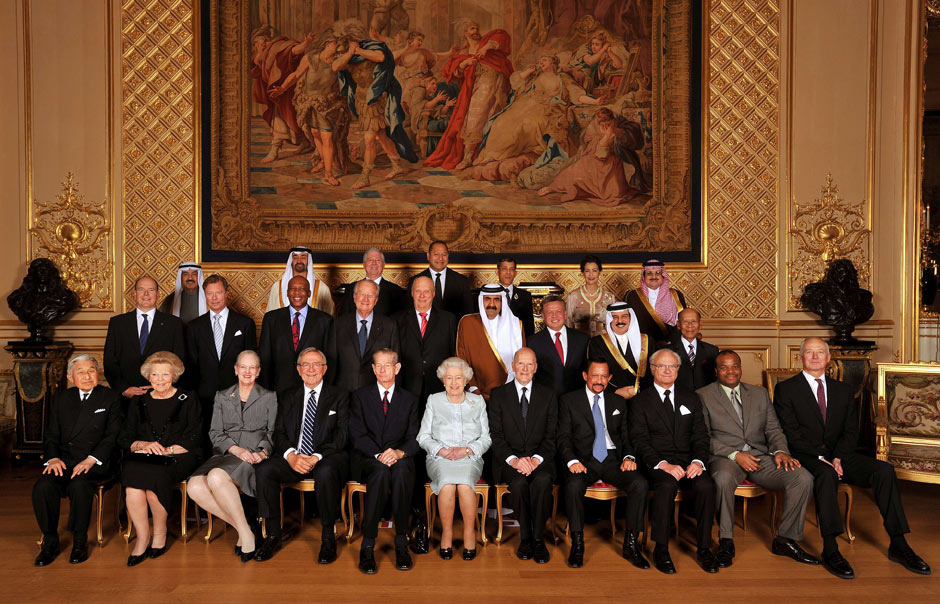
The Queen poses for a formal picture with her guests before a sovereign monarchs jubilee lunchView larger picture
The Queen poses for a formal picture with her guests before a sovereign monarchs jubilee lunch at Windsor Castle. Photograph: John Stillwell/AFP/Getty Images

It was meant to be a monarchical milestone, an unprecedented meeting of the world's crowned heads gathered at Windsor Castle in celebration of theQueen's diamond jubilee.

But as the kings, queens, princes, one emperor, a grand duke and an emir posed for a historic photograph inside the castle's Waterloo Chamber, elsewhere human rights activists condemned it as a platform for "blood-stained despots and tyrants".

Perhaps, the Queen's advisers may have reflected, this glittering anniversary bash was not such a good idea after all.

Taking his seat amid the heraldic splendour of St George's Hall, was King Hamad al-Khalifa of Bahrain, whose regime is accused of the brutal suppression of pro-democracy demonstrations.

Swaziland's controversial King Mswati III, who has amassed 13 wives and an estimated £60m personal fortune, according to Forbes magazine – while many of his 1.2 million subjects live in poverty – was seated nearby.

Saudi and Kuwaiti royals, criticised for their human rights records, also feasted from a menu which included English asparagus, Windsor lamb, wild mushrooms and Kent strawberries, paid for by the taxpayer, via the Sovereign's Grant.

The Queen had rolled out the full red-carpet treatment with the Duke and Duchess of Cambridge, Prince Harry and princesses Beatrice and Eugenie among a 12-strong royal welcoming party. Prince Charles was not there, as he was hosting his own glittering dinner at Buckingham Palace on Friday night for the foreign rulers, excluding King Hamad, who was not attending.

The Queen welcomed the Bahraini ruler with a handshake and a laugh as the two shared a joke.

But detractors condemned the event as a "catastrophic error of judgment". It was, pronounced the chief executive of the pressure group Republic, Graham Smith, a "crisis of her [the Queen's] own making". "Thanks to the Queen's misjudgment, her jubilee will forever be associated with some of the most repressive regimes in the world," he added.

Denis MacShane, a former foreign office minister, said: "Given the amount of blood on the hands of the royal regime in Bahrain it's a shame he will stain the white linen of Windsor Castle at this event."

MacShane laid responsibility at the door of the Foreign Office. It has said invitations were sent by the royal household. Some 21 sovereign monarchs, and six representatives, made up the largest such gathering of foreign royals since Queen Victoria's golden jubilee celebrations, captured in a painting by Laurits Tuxen. Not all, though, still had thrones – the royals of Bulgaria, the former Yugoslavia and Romania, for example, and the Hellenes. In the formal photograph, King Hamad was a diplomatic distance away from the Queen, though that was because the seating appeared to be arranged on length of regal service.

Showing no indication of being aware of the controversy surrounding his attendance, the Bahraini ruler convulsed into a fit of giggles as the photographer began taking the picture. Also laughing was the Sultan of Brunei, sitting in front. "Are you supposed to be enjoying this?" joked the Queen.

In some respects the lunch was something of a family affair featuring Europe's three queens: Elizabeth II, 86, Margrethe II of Denmark, 72, and Beatrix, of the Netherlands.

Many guests were the Queen's "kissing cousins", which happily dispensed with protocol over who should pay obeisance to whom. Queen Beatrix flung open her arms as she approached the Queen, before kissing her.

Bowing and curtsying was limited. Lest anyone be doubt as to who had precedence, however, it was Her Majesty - with Great Britain and 15 other realms notched on her belt. This being lunchtime, it was lounge dress and no proper bling.

The ghost of Victoria loomed large. Not for nothing was she known as the "grandmother of Europe", with her descendants present including the Queen, Prince Philip, Margrethe, King Harald of Norway, 75, and King Carl Gustaf of Sweden, 66.

Another would have been Spain's Queen Sofia, but she was prevented from attending by her government, furious over a planned visit by the Earl of Wessex to Gibraltar, the UK overseas territory Spain wants back.

Protesters stayed away from Windsor, except one, who called himself Joe. Others were planning to demonstrate outside Buckingham Palace on Friday evening, an event, as it turned out, the Bahraini ruler was not due to attend.

The Swazi Vigil protest group had waved placards outside the Savoy hotel, where Mswati was said to be installed with a 30-strong entourage, rather than Windsor. They did not, said protest co-ordinator Thobile Gwebu, want to "spoil" the Queen's jubilee celebrations. But, she added, they had written to Her Majesty politely asking if she could perhaps "have a word" with the Sherborne-educated absolute monarch.

Joe, meanwhile, waved his placard as the crowned heads arrived in cars at the Long Walk at Windsor Castle. "I booed at the King of Bahrain's car," Joe said proudly. "But right behind it was the Emperor of Japan's car. I was still booing and the Empress had the window down and was waving. She looked a bit startled and stopped waving straight away," he said.

Posted via email from projectbrainsaver

Alan Milburn: 'Threat to new era of social mobility' Major report warns that fewer people outside the middle class have a chance to join professions Daniel Boffey, policy editor guardian.co.uk, Saturday 26 May 2012 23.57 BST

Alan Milburn: 'Threat to new era of social mobility'

http://www.guardian.co.uk/society/2012/may/26/alan-milburn-social-mobility

Major report warns that fewer people outside the middle class have a chance to join professions

Alan Milburn
Britain has a chance to recreate the 1950s ‘golden era’ of professional opportunities, says Alan Milburn. Photograph: Matthew Fearn/Press Association

The government's adviser on social mobility will warn in a major report that the country risks squandering the chance to recreate the golden era of the 1950s, when workers from all parts of society had the chance to join the professional classes.

Alan Milburn, the former Labour health secretary, will tell ministers that despite a huge growth in white-collar work, there is evidence that people from poorer backgrounds and those living outside the south-east of England are being left behind.

The report, due to be published on Wednesday, claims that 83% of all the jobs created over the next decade will be in the professions. Today, 42% of the working population (13 million people) work in a profession and by 2020 this will increase to 46%.

Yet, in an example of the increased social exclusivity of the top echelons in Britain, Milburn found that while 30% of members of parliament were privately educated in 1997, that proportion increased to 35% in 2010. In the Labour government's last cabinet, 32% were privately educated but this increased to 59% in the coalition cabinet that entered Downing Street in May 2010.

Speaking to the Observer, Milburn said the country had the opportunity to encourage a level of movement between the classes last seen in the 1950s but that he had found no evidence of this happening. He said: "The chances of social mobility are greater if there are more professional jobs being created. So it is no coincidence that the 1950s saw an unparalleled social mobility in Britain and that coincided with an upsurge in professional employment.

"In the 1950s, the academics say there was the creation of more room at the top. The economy was becoming more professional, more white-collar jobs created, demands [increased] for higher quality, higher skill level and the sucking up of labour into the white-collar, better-paid jobs.

"The primary reason that social mobility has stagnated in the last 30 years is that there has been another big change in the labour market: the advent of a more knowledge-based economy where there is a high premium on qualification and skill and if you have those you get into the inner circle, if not there is constant insecurity, low pay and endemic poverty."

Milburn added: "It seems that what is happening, as part of this growth of the middle class in our country, is that the jobs that are going to be created are overwhelmingly in professional careers. The question is: who gets the jobs? There is a real opportunity.

"And so the question at the heart of the report is whether the growth in professional employment is going to create a new social mobility dividend for Britain just as there was in the 1950s. And the short answer is: not yet."

Milburn's report – the first of three on social mobility commissioned by deputy prime minister Nick Clegg – will tell ministers that the recruiting policies of big employers are largely responsible for the lack of social progress.

He found that of the 115 universities in the country, on average only 19 are targeted by the UK's leading professional employers as part of their graduate recruitment drives. Milburn, who also examines the role of universities and government in causing and or, possibly, solving the problem, said: "Those universities are the more socially exclusive in the country so those recruitment practices merely enforce the social exclusivity of the professions. It is an interesting argument that of the 115 universities only 19 are capable of producing excellent graduates. I think there are 30-odd universities in the Russell Group alone. So they don't even get to all of them." Evidence suggests that the "socially exclusive" recruitment policies of the major employers exacerbate the north-south divide.

Milburn will call for employers to follow the example of the last two governments in moving civil service jobs to the regions.

He said: "We looked at where the Times top 100 graduate employers, who were overwhelmingly professional employers, were offering vacancies. In 2012, nine out of 10 of those companies were offering vacancies in London. Only 44% in the north-east; only 41% in East Anglia. Unsurprisingly in the next few years, over half the growth of jobs in higher-level occupations will occur in London and the south. It seems that regional disparities in being able to get on the professional career ladder are growing. And are set to go on doing so.

"Interestingly, the previous Labour government, and this one, have set a rather good example in that they have actively dispersed their civil service workforce . And as a consequence they created new white collar opportunities in the regions and other nations of the UK. What these regions have going for them from an employer's perspective is there is a youthful labour market and a cheaper labour market. Which is of course why the government has done it.Maybe where the government has led, the professions can follow."

Posted via email from projectbrainsaver

the guardian - polly toynbee - Queen's diamond jubilee: a vapid family and a mirage of nationhood. What's to celebrate?

theguardian

01.06.12
Updated 11.10

http://m.guardian.co.uk/commentisfree/2012/may/31/queen-diamond-jublilee-why-celebrate?cat=commentisfree&type=article

Queen's diamond jubilee: a vapid family and a mirage of nationhood. What's to celebrate?

If the very idea of monarchy diminishes us, the living reality is much more humiliating and damaging to our country
Joe Magee 0106
Illustration by Joe Magee
Polly Toynbee

The Guardian, Thu 31 May 2012 21.00 BST

Comment

The mighty royal jubilee bells will toll their way down the Thames on Sunday on a floating belfry leading a thousand boats, echoed by pealing church bells all down the riverside. Who could miss the spectacle of a hundred tall ships serenaded with Handel's Water Music played by a floating orchestra?
The more outrageously glorious the performance, the more preposterous its purpose. There at the heart, in the dead centre of all this pomp and circumstance, is the great emptiness, the nothingness, the Wizard of Oz in emperor's clothes. The louder the bells, the more gaping the grand vacuity. What are we celebrating? A singularly undistinguished family's hold on the nation, a mirage of nationhood, a majestic delusion.
How close to religion it is, with all the same feudal imagery, God as Lord and sovereign, sovereign anointed by God, knelt before in a divine hierarchy of power ordained by laws too ineffable to explain. The tyranny of the monarchy lies not in its residual temporal power but in its spiritual power. It subjugates the national imagination, infantilising us with false imaginings and a bogus heritage of our island story. For as long as they rule over us, we are obedient servants, worshipping an ermine-wrapped fantasy of Englishness. (Despite the kilts, the monarchy was never really British.)
Every country needs its founding myths, its binding identity rooted in a valiant story that rarely stands up to historical scrutiny. What matters is the nature of that story, and ours is as pitiful as our embarrassingly shoddy national anthem: no US "land of the free", just "long to reign over us".
But if the very idea of monarchy diminishes us, the living reality is even more humiliating. What are we doing paying homage to the unimpressive personages invested with this awe? They are the apogee of celebrity culture, because there is nothing there but empty celebrity. Ah, say the royalists, it's their very "ordinariness" that is their mystique. But they are not ordinary like next-door neighbours, only ordinary like all the other dull and talentless plutocrats with nothing remarkable about them but their bank balance. That the very rich are mostly very dull, lacking enterprise, initiative or inspiration is small solace.
The long line of royal nonentity is the ultimate lesson in the damage that inherited money and privilege does, the reason why inheritance tax – which the monarchy doesn't pay – is a way not just to collect funds for the Treasury but to stop the stultifying social effects of inherited wealth. How well the royal family illustrate the aristocratic phenomenon where those who have had the very best education and the greatest opportunity for intellectual enrichment emerge with so little to show for it, generation after generation. Hunting, shooting, horses, nightclubbing, none of the long royal line since time immemorial has exhibited much spark of intellectual curiosity or originality.
It is a joyful confirmation of the wonder of the human gene pool that talent, brains and charm spring up at random. These faculties are no more bred out of a fictional "underclass" than they are bred into a fictional "royal blood", though social circumstance conspires to knock it out of some at a young age, while promoting others with no attributes to heights they would never reach on merit. If royals have any value, they are the living, breathing negation of the myth of genetic superiority.
The most enjoyable reminder was theQueen's diamond jubilee "informal" lunch for 20 crowned heads, when the theatre of majesty descended into farce. If she thought collecting them together would add legitimacy to the bloodline idea, what a mistake. The display of dictatorship and delusion surely must have been devised by some secret palace republican, complete with group photo of the torturers of Bahrain, Saudi Arabia, Swaziland and Qatar, alongside dethroned fantasists from Romania and Greece, a showcase of royalty from horror to hilarity, from ruthless to Ruritanian.
With its usual thundering ineptitude, the government chose jubilee week to publish a report on Britain's social immobility. Alan Milburn offers a snapshot of a country where birth is destiny more surely than virtually every other OECD nation except the US. With 83% of new jobs in the next eight years in higher management and the professions, on the present trajectory the odds that many more children from blue collar backgrounds will shoot up the ladder to take them are vanishingly remote.
New opportunities, like the last decade's extra university places, are taken by dimmer, better-crammed children of a middle class more adept at cementing their children into the upper echelons than ever. The privileged are not about to let them slip down the ladder to make room for others any time soon, and Michael Gove's selective education policies will help prevent it. Income gaps stretch wider, as the bottom half has stagnated for a decade. Nick Clegg's claim that income difference is unlinked to opportunity defies every international comparison: only more equal countries produce more equal opportunities. But here we are, in a deeper depression than the 1930s, with austerity imposed hardest on the weakest, lavishly celebrating our figurehead of British class rigidity.
The cost of the monarchy, though a hundred times the price of the modestly likeable Irish presidency, is counted not in palaces and royal trains, but in the fantasy of imperial power the crown bestows on British politics. Punching above our weight, we have just ordered a new Trident to cling to an undeserved UN security council seat from which to hector the world about a democratic idea so weakly applied at home.
Meanwhile, defrauding ourselves and the world's treasuries, the sun never sets on the Queen's dominion over more tax havens than any other country, an archipelago of shame from the Channel Islands, the Isle of Man, the Cayman Islands, Turks and Caicos, Gibraltar, Bermuda, the British Virgin Islands – and the City itself. Beneath the splendour, the squalor.
The Republic protest takes place at City Hall at 1.30pm on Sunday

Posted via email from projectbrainsaver